The entire sterilization process of the sterilizing pot adopts PLC fully automatic linear control. The temperature inside the tank is controlled at ±0.2°C. The multi-stage temperature control can ensure heating, constant temperature and cooling segmented control and powerful delay function. High-fidelity pressure simulation curve control ensures It provides the pressure compensation and back pressure in the can sterilization process and the pressure control of the sterilization of special products. The on-site is equipped with a large touch screen that can store multiple sterilization formulas, and new sterilization formulas can be easily input on-site, which is suitable for producing multiple products in one pot. The powerful display function of the display screen allows the operator to grasp the entire sterilization process in time, and the advanced human-machine dialogue function allows the operator to complete the operation simply.
There are many types of sterilization pots. In traditional high-temperature sterilization in my country, water bath sterilization and steam sterilization are commonly used, that is, water sterilization and steam sterilization. In the 1990s, in order to meet the production requirements of special products such as flexible packaging, double-layer retorts, namely Japanese retorts, were introduced from Japan. At the beginning of the new century, Spain, Germany, France and other European countries. In order to save energy and water resources, a water spray sterilizer with a heat exchanger is introduced. Especially in France, a sample steam circulation system is used to achieve the goals of high temperature, energy saving, short time, high efficiency and water saving. Most domestic sterilizing pots adopt the concept of Japanese pots. For two years now, they have simulated water spray sterilization of heat exchangers in European technology. On the basis of the sterilizing pot, a new concept of mixed water vapor sterilization is proposed. On the basis of inheriting France's advantages of high temperature, energy saving, short term and water saving, it has optimized the heat distribution effect in the pot and is world-renowned.
The purpose of the sterilizing pot is to sterilize various products suitable for high-temperature sterilization, so that the products can be stored at normal temperatures for a longer period of time, and users can produce them in large quantities. It is more conducive to long-distance transportation. Within a certain period of time, the product will not come into contact with the outside world, so that the product can be stored for a long time without deterioration. Spray-type and water-bath sterilizing pots are suitable for soft packaging of cans, meat, fish, corn, vegetables, dairy products, and products in tinplate cans and glass bottles. Rotary sterilizing pots are mainly used for the production of eight-treasure porridge and other products. They are sterilized at high temperatures. During the process, the product is rotated in the pot body to solve the problem that the viscous canned food with different concentrations will not stratify or settle during the shelf life.
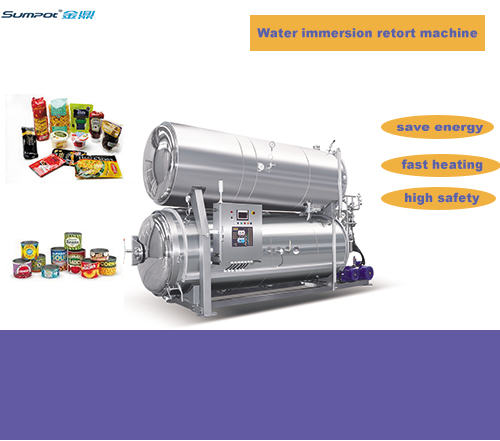
(1) Sterilization method: Different sterilization methods are selected according to different products, and the sterilization pot is simply divided into:
① Water bath sterilization: It consists of an upper hot water storage tank and a lower sterilization pot. The hot water storage tank and the sterilization pot are the same size. The hot water storage tank is preheated by steam (temperature controllable). The softened water can be recycled after sterilization. , the recovered softened water is still hot water. During sterilization, the hot water relies on the circulation pump to circulate in the sterilization pot and circulation pipes. At this time, the hot water storage tank is empty.
②Steam sterilization: After the food is put into the pot, steam is directly added to heat it up, and the steam and air are kept mixed through the circulation device to circulate in the sterilization kettle.
③Spray sterilization: The upper tank is preheated in advance. The softened water can be recycled after sterilization. The recycled softened water is still hot water. It contains nozzles, divided into spray water, side spray, top spray and full spray, and upper softened water. After falling, use the nozzle to spray hot water in mist-like waves onto the surface of the food. Spray water mist to break up the cold air mass in the tank. Under the action of spray water mist, the temperature is ensured to be uniform without dead corners and no cold air mass.
(2) Heating method: steam heating, electric heating, etc.
(3) Control classification:
1. Manual control type: All valves and switches require manual control of the valve switches; manual setting of the sterilization time and sterilization temperature also requires workers to adjust according to the thermometer, and manual operation is required for cooling.
2. Electrical automatic control type: The cooling process requires manual control of the water pump to inject cold water. The pressure is controlled by an electric contact pressure gauge (one gauge controls two valves, air supply valve and exhaust valve). The temperature is controlled by a sensor (pt100) and an imported temperature controller. Control automatically.
3. Computer board automatic control type: The cooling is manually controlled, using PLC and text display to process the collected pressure sensor signals and temperature signals. The sterilization process can be stored, the control accuracy is high, and the temperature control can reach ±0.3°C.
4. Computer fully automatic control type: Except for the entry and exit of food and the opening and closing of doors, which require manual operation, everything else is controlled by microcomputer. The entire process is controlled by PLC and touch screen, and the sterilization process can be stored. The operator only needs to press the start button. After the sterilization is completed, an automatic alarm will occur, and the temperature control accuracy can reach ±0.1°C.
(4) From the tank structure:
1. Single-tank sterilization pot
2. Double-layer sterilization pot
3. Vertical sterilization pot
4. Electric and steam dual-purpose sterilizer
5. Rotary sterilizing pot
6. Double-pot parallel sterilizing pot
(5) From the pot material:
1. All-steel type A: The sterilizing pot is all made of stainless steel.
2. All-steel Type B: The pot body and jacket of the retort are made of stainless steel, and the frame is made of carbon steel.
3. Semi-steel type: The pot body of the product is made of stainless steel, and the jacket frame is made of carbon steel.
4. Carbon steel type: All products are made of carbon steel
(6) According to the appearance form: single pot, double layer, three pots in series, etc.
Common sizes of sterilizing pots: DN700-1200, DN900-180, DN1200-2000, DN1200-3600, DN1500-3600, DN1500-4400, etc.
SUMPOT retort sterilization machinery company has a rich experience of manufacturing retort autoclaves, we have been exporting to all over the world in the past 28 years already, we have more than 200 professional workers servicing our customers and providing professional sterilization solution, if you want to know more about our retort equipment, please fill out our inquiry form,we will contact you very shortly.

