As more and more instant meals are produced nowadays, people pay more and more attention to the demand for food safety. Food sterility and food preservation technology dominate food safety. Food sterilization has also become the most critical link in the entire production process of the food industry. So what exactly is retort processing in food industry? 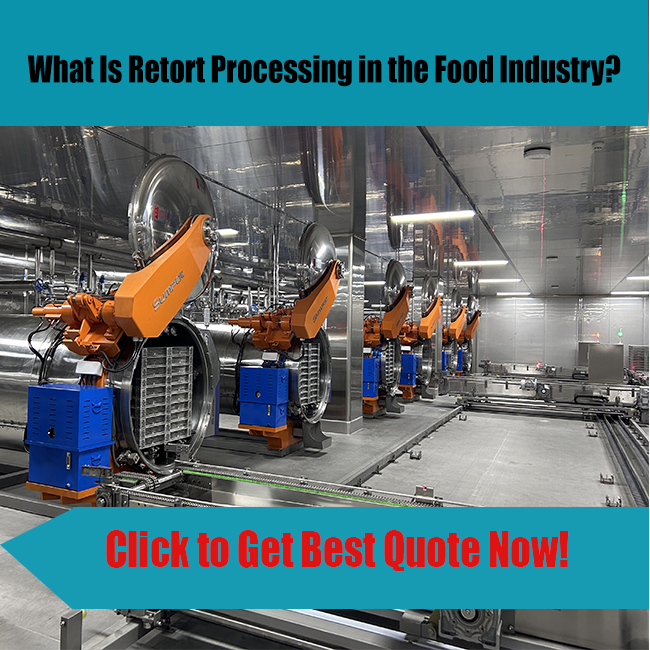
Retort processing, sometimes also named as autoclave processing or sterilizer processing, depending on the customary name of different countries, is a type of equipment used in the food industry for thermal sterilization processing. Its purpose is to eliminate microorganisms in packaged products through high temperature and high pressure to extend the shelf life of food and ensure food safety, maximize the nutritional value, color and flavor of food while sterilizing it.
In order to give you a comprehensive understanding of the heat treatment of retort food processing, we will introduce you to the retort processing temperature and time, types of retort processing, retort processing steps etc.
1. Retort Processing Temperature and Time
The sterilization temperature and time of retort processing vary depending on different food content and packaging types, The temperatures typically range from 110°C to 135°C (230°F to 275°F), the regular retort processing temperature is around 121℃, mostly suitable for cans, pouches, bottles, trays etc. The SUMPOT unique linear system can very accurately regulate sterilization temperature and pressure, maintaining the original flavor, texture, color, etc. of food while sterilizing.
2. Types of Retort Processing
SUMPOT retort machine adopts a variety of excellent sterilization technologies, mainly including the following methods:
Water Spray Retorts:
This type of heat treatment sterilization uses a spray of hot water to heat, spray it into a mist through a nozzle, and spray it directly on the surface of the food to achieve a mild and uniform sterilization effect. It is more sterilizing for fragile product packaging (such as glass bottle packaging) Friendly, the use of large-flow water pumps can quickly realize the heating and cooling of products, saving energy and time. This thermal sterilization method is suitable for cans, pouches, bottles,trays, and has a wide range of uses.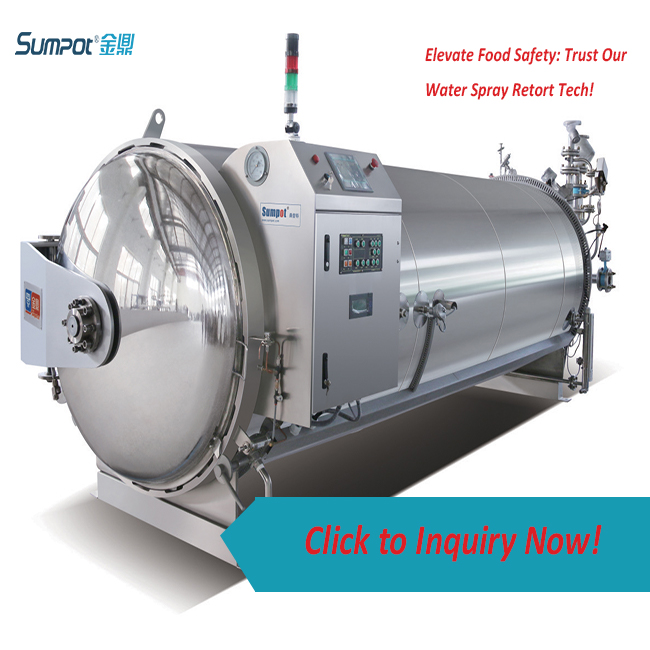
Water Immersion Retorts:
In this process, the packaged food is completely immersed in the heated water, and the heat is evenly distributed through the circulation of hot water through the upper and lower tanks. This way the heat distribution effect is better. The temperature dispersion value is ≤ +0.5℃, which can achieve 360-degree sterilization without dead corners Sterilization without dead corners, especially suitable for products in large packages that are not easily penetrated by heat. Suitable for sterilization of flexible packaging, canned, and bottled products.
Rotary Retorts: Different from static sterilization pots, the shaking sterilization pot will slightly shake or stir the food during heat treatment to promote the flow of liquid in the package, make the heat distribution more even, avoid local overheating or incomplete sterilization, and make the product heated evenly. Suitable for thicker food, such as bird's nest, porridge, etc. 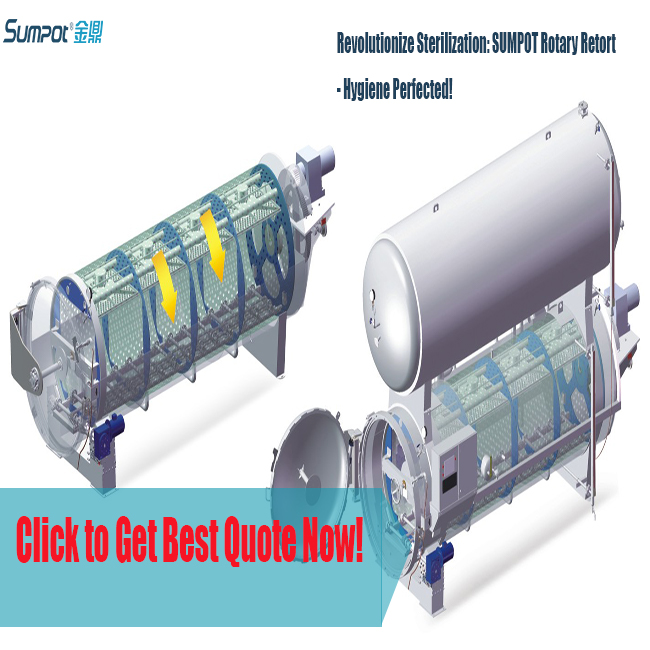
Steam Air Retorts:
Steam air retort processing means that steam and air exist in the retort at the same time, but there is no exhaust process. Instead, a circulating fan is used to circulate the steam and air in the retort chamber at high speed, and they are fully mixed and stirred to make the temperature in the retort reach a uniform state. It combines the two technologies of steam and spray. Direct heating by steam and spraying with a small amount of circulating hot water not only ensures the sterilization efficiency, but also realizes the effective use of energy. Applicable for cans, pouches, glass jars.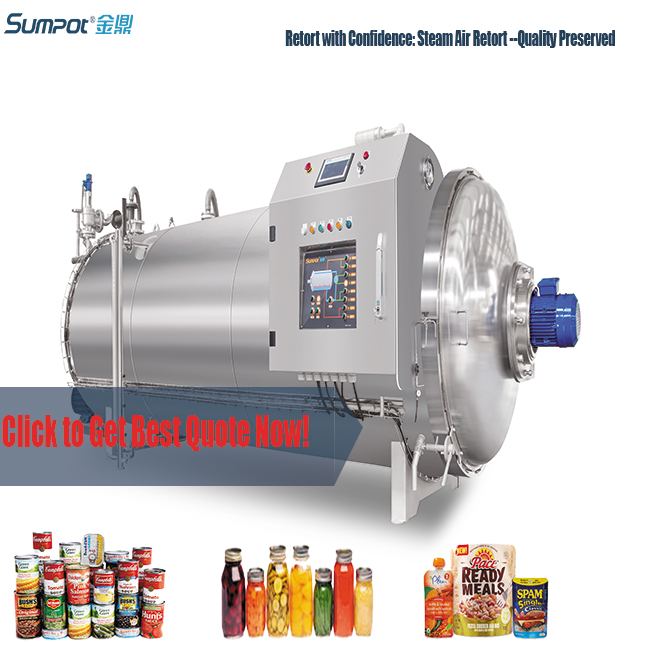
1. Retort Processing Steps
1. Preparation: Ensure that all products to be sterilized have been well packaged and sealed, and place the sealed products into the retort machine.
Preheating:
Inject an appropriate amount of water into the retort, directly heat it with steam, and quickly raise the temperature to the required sterilization temperature (usually around 121°C). At the same time, the pressure is adjusted to a predetermined level through the pressure valve and exhaust valve.
Sterilization:
The steam directly enters the sterilization retort for heating, while the circulation pump promotes water circulation in the system to ensure that the product is heated evenly. Sterilization time varies from about 15 minutes to several hours depending on different food types and packaging materials.
Cooling:
After sterilization, the process enters the cooling stage. In order to quickly and effectively reduce the temperature of the food, the product is usually cooled twice. The supply of steam in the retort will be stopped, and cooling water is introduced into the retort machine for cooling. The cooling phase ends until the product has cooled down to the desired temperature.
Unloading:
After retort processing, the packaged food is taken out of the retort,and wait for subsequent packaging, etc.

